Showing posts with label Fountain. Show all posts

Monday, 19 January 2015

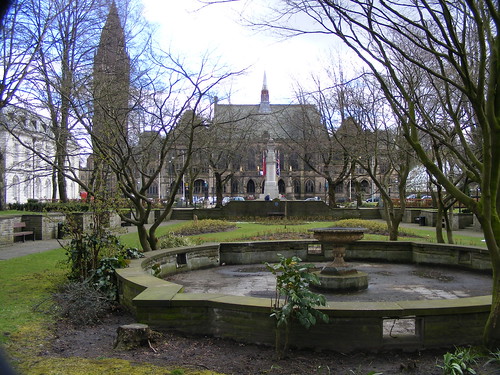
Drinking Fountain in Alexandra Park, Whalley Range, Manchester, UK Made Andrew Handyside in 1868. Now Restored.

Alexandra Park is a 60-acre park in the Moss Side/Whalley Range districts of Manchester, England. It was designed by Alexander Hennell, opened in 1868. In 2012 a two year £5.5m restoration project to return the park to its original Victorian glory started. The restored park reopened in August 2014.

Part of the restoration included a Drinking fountain made by Andrew Handyside of Derby. I'm so happy to see this fountain restored, it looked in pretty bad shape but thanks to the hard work of Hargreaves Foundry from Halifax its now looking very good. Andrew Handyside would be proud to see his fountain looking like this 146 years after it was installed in this park.

This very same fountain can be found in the grounds of St Pancras Old Church in London, UK and also one in Geelong, Victoria, Australia called "The Belcher Drinking Fountain"

Here are some photographs of this Handyside drinking fountain after its restoration in 2014 :


This is Fountain Design No. 48 on Page 40 of my 1879 publication "An Illustrated book of Designs for Fountains and Vases, costing from £1 to £1200 manufactured by Andrew Handyside".


Here are some photographs showing the poor state the drinking fountain was in prior to restoration :


I found this rather interesting old photograph of the drinking fountain from 1954. These people are from The Band of Hope, part of the Temperance Movement in Manchester. Click to view a large version.
The fountain as seen in 1954 (Copyright Livesey Collection UCLan)


Useful links :
Friends of Alexandra Park Facebook page.

Blog entry by Hargreaves Foundry about their restoration of the fountain.

Andrew Handyside exported many decorative fountains around the world during the Victorian era.
The Britannia Foundry's work was well known for its fine quality so these fountains can be found all over the globe but where exactly they are located is difficult to find out.

Thankfully because of my research here people are beginning to contact me with details of Handyside work, I am then able to add it to my world map. It really helps my research being able to use Flickr to see these items for myself and share these finds with the world!

Thanks
Andy Savage

Tuesday, 6 January 2015

Fountain in Rochdale Memorial Gardens made by Andrew Handyside. Now restored !

This restored fountain is located at the North end of Rochdale Memorial Gardens.

I was told about this restoration back in 2011 by Bob Bevan a Rochdale Township Greenspace Ranger. I supplied them information to try and help with the restoration and I'm happy to say this fountain is now up and running again.
I made a special trip from Derby to see this fountain and meet up with Bob, he gave me an amazing tour of the local sites and heritage which was very interesting.

In my video you will see just below the large bowl of the fountain are busts of Peel, Nelson, Watt, Wellington, Stephenson, Scott, Shakespeare and Milton.

This particular design of fountain is listed as Design Number 27 on Page 70 of the 1879 publication "An Illustrated book of Designs for Fountains and Vases, costing from £1 to £1200 manufactured by Andrew Handyside".

My video of the restored fountain in Rochdale Memorial Gardens.


I have also created three 360 degree VR photographs of this fountain so you can have a look around the Memorial Gardens:

http://www.absolutelyandy.com/demo/360s/rochdale/4810_4816.htm

http://www.absolutelyandy.com/demo/360s/rochdale/4820_4826.htm

http://www.absolutelyandy.com/demo/360s/rochdale/4803_4809.htm


Here is a photograph taken in 2008 when the fountain was dry and waiting restoration :

Rochdale Memorial Gardens


Thanks
Andy

Thursday, 1 March 2012

Old Drinking fountain Alum Chine, Westbourne, Bournemouth, UK built by Andrew Handyside in the 1880s

Andrew Handyside who made Friar Gate bridge in Derby also made lots of fountains. These fountains were made right here in Derby at the former Britannia Ironworks on Duke Street.

The Britannia Foundry's work was well known throughout the Victorian Era for its fine quality, so these fountains can be found all over the globe but where exactly they are located is difficult to find out. But thankfully because of my extensive research here, people are beginning to contact me with details of Handyside work. I am then able to add it to my Handyside world map and this blog, where I can go into great details about every item I find including historical information, Photographs from Flickr, Videos from Youtube, Exact map locations, Google Streetviews etc.

Here is one that I found last year but was waiting for someone to take some better photographs of it for me, thankfully Alwyn Ladell from Bournemouth has now taken some great shots of it which I can now share.
This Disused Drinking Fountain by Andrew Handyside is located on the beach at Alum Chine, Westbourne, Bournemouth, Dorset, UK.

This particular design of drinking fountain is listed as Design Number 24 on Page 42 of the 1879 publication "An Illustrated book of Designs for Fountains and Vases, costing from £1 to £1200 manufactured by Andrew Handyside".
The price for this fountain is listed in April 1880 as between £18 0s 0d and £20 5s 0d depending what finish was applied (no finish, bronze/marble paint etc).
According to the drawing its 6 foot 7 inches from the base to the bottom of the lamp support and includes a animal drinking trough in the base. Looking at the photographs of this fountain it does still have those on place unlike the Curling Drinking fountain in Eastbourne.

Its a real shame that this Victorian drinking fountain has been allowed to get into this sorry state.
This is probably around 140 years old and has been left to rot. I'm very surprised that this has been allowed to happen, perhaps the council don't realise what they have here! Is it even listed? 
Perhaps if you live in this area you should let someone who cares know about this neglected fountain.

This fountain is missing the water spout, the two cup holders and the lamp on the top. It DOES however still retain the Handyside plaque which the Eastbourne fountain does not.

Photographs of this old drinking fountain.

Front view of the drinking fountain showing the two intertwined dolphins on the top, Looks like the lamppost has rotted away.
Disused Drinking Fountain by Andrew Handyside, Alum Chine, Westbourne, Bournemouth, Dorset

Angled view of the fountain, at this angle you can see one of the animal drinking troughs in the base.
Disused Drinking Fountain by Andrew Handyside, Alum Chine, Westbourne, Bournemouth, Dorset

The "A. Handyside & Co Ld" plaque located at the top of the fountain just below the dolphins.
Disused Drinking Fountain by Andrew Handyside, Alum Chine, Westbourne, Bournemouth, Dorset

The Handyside logo located on the ??????? of the fountain.
Disused Drinking Fountain by Andrew Handyside, Alum Chine, Westbourne, Bournemouth, Dorset

Photograph of the fountain from 2009 by Martin R :
bournemouth & boscombe sea front

A Postcard from 1926 showing the fountain, probably in working at this time :
Alum Chine estuary, Westbourne, Bournemouth - eastern cliffs and steps

I found another photograph of this fountain on Geograph.

This exact same model of drinking fountain in great condition can be found in Eastbourne, see my blog post on this other fountain here - Eastbourne fountain.


Map Location:
View my Andrew Handyside World Map to see the exact location of this fountain on my world map.
My world map is the result of hundreds of hours of research into the company, plotting out each item as I find it.

Can you help find more Andrew Handyside stuff ?
If anyone out there knows of any other Fountains around the world bearing the Handyside badge that I have not mentioned yet then please get in touch with details, location, photographs etc.

Thanks
Andy

Wednesday, 25 January 2012

Fountain in Pearson Conservatory, St. Georges Park, South Africa, Made By Andrew Handyside about 1882.

Andrew Handyside who made Friar Gate bridge also made lots of decorative fountains. These fountains were made right here in Derby at the Duke Street Foundry "Britannia Iron Works". Andrew Handyside exported many decorative fountains around the world during the Victorian era.  The Britannia Foundry's work was well known for its fine quality so these fountains can be found all over the globe but where exactly they are located is difficult to find out.

Here is one I found last year but decided now was a good time to post about it due to the fact that I've just seen it in the background of a TV Advert !!!
This Handyside fountain is located inside the Pearson Conservatory, St. Georges Park, South Africa. It was made in Derby around 1882.

This particular design of fountain is listed as Design Number 15 on Page 30 of the 1879 publication "An Illustrated book of Designs for Fountains and Vases, costing from £1 to £1200 manufactured by Andrew Handyside".  Its the same design as the one at Prince Alfred College, Adelaide, Australia. and the one at Sarmiento School Fountain in San Miguel de Tucuman, Argentina, South America.

Photograph of the Handyside fountain :


The TV Advert for Truvia sweetener that features this fountain.

The advert was filmed in St. Georges Park, South Africa, the advert is set in a greenhouse originally brought from Scotland in 1882. Filled with hundreds of locally grown Stevia plants, the scene brought beauty and nature together in perfect syngery. In the advert Ebony Buckle, a classically trained singer takes centre stage as she sings ‘Truvia® Scrumptious’ to the tune of Chitty Chitty Bang Bang’s iconic ‘Truly Scrumptious’.

Map Location:
View my Andrew Handyside World Map to see the exact location of this fountain on the world map.
My world map is the result of hundreds of hours of research into the company, plotting out each item as I find it.

Can you help find more Andrew Handyside stuff ?
If anyone out there knows of any other Fountains around the world bearing the Handyside badge that I have not mentioned yet then please get in touch with details, location, photographs etc.

Thanks
Andy

Sunday, 1 January 2012

Drinking fountain in St Pancras Old Church Gardens built by Andrew Handyside in 1877.

Andrew Handyside who made Friar Gate bridge also made lots of decorative fountains. These fountains were made right here in Derby at the Duke Street Foundry "Britannia Iron Works".

Andrew Handyside exported many decorative fountains around the world during the Victorian era.
The Britannia Foundry's work was well known for its fine quality so these fountains can be found all over the globe but where exactly they are located is difficult to find out.
Thankfully because of my research here people are beginning to contact me with details of Handyside work, I am then able to add it to my world map. It really helps my research being able to use Flickr to see these items for myself and share these finds with the world.

This drinking fountain is located in the gardens of St Pancras Old Church, London.
Dated 1877 on plaque. Manufactured by Andrew Handyside and Co of Derby for William Thornton, a
senior Church Warden who presented it to the church.

This particular design of fountain is listed as Design Number 48 on Page 40 of the 1879 publication "An Illustrated book of Designs for Fountains and Vases, costing from £1 to £1200 manufactured by Andrew Handyside".

There is another of these fountains and in much better condition in Australia.
See my post : Belcher Drinking Fountain in Geelong, Victoria, Australia.

Photographs of this fountain.

View of the fountain in the Church gardens.
Handyside drinking fountain at St Pancras Old Church, London

View of the top of the fountain.
Handyside drinking fountain at St Pancras Old Church, London

The makers badge on the base of the fountain.
Handyside drinking fountain at St Pancras Old Church, London

Showing the location of the fountain within the church gardens


Handyside drinking fountain at St Pancras Old Church, London


Google Streetview of this fountain.

Map Location:
View my Andrew Handyside World Map to see the exact location of this fountain on the world map.
My world map is the result of hundreds of hours of research into the company, plotting out each item as I find it.

Can you help find more Andrew Handyside stuff ?
If anyone out there knows of any other Fountains around the world bearing the Handyside badge that I have not mentioned yet then please get in touch with details, location, photographs etc.

Thanks
Andy

Friday, 12 August 2011

Handyside Fountain in gardens of Temple Newsam House, Leeds, West Yorkshire, UK

Andrew Handyside who made Friar Gate bridge also made lots of decorative fountains, they were renowned for their high quality and much sort after around the world. Many examples of their work are still in use today.
These fountains were made right here in Derby at the Duke Street Foundry "Britannia Ironworks".

Andrew Handyside exported many decorative fountains around the world during the Victorian era.
The Britannia Foundry's work was well known for its fine quality so these fountains can be found all over the globe but where exactly they are located is difficult to find out.
Thankfully because of my research here people are beginning to contact me with details of Handyside work, I am then able to add it to my world map. It really helps my research being able to use Flickr to see these items for myself.

This fountain is located in the gardens of Temple Newsam House in Leeds. The fountain was Grade II listed on 5th August 1976. As you can see in the photographs below its not in bad condition apart from one of the Lions hears seems to be damaged.

This particular design of fountain is listed as Design Number 19 on Page 18 of the 1879 publication "An Illustrated book of Designs for Fountains and Vases, costing from £1 to £1200 manufactured by Andrew Handyside". This same design of fountain is in Tucuman Argentina.

Video
A short video of the Temple Newsam Fountain working. Click the PLAY button to view it.


Photographs
Photographs of the Temple Newsam Fountain:
1) Stunning shot of the complete fountain
Quiet Fountain

2) A shot showing the location of the fountain in front of the house.
Temple Newsam

3) A view showing the underneath of the top bowl and the two cherubs as well as the
three Baroque style dolphins which you often find on Handyside fountains.
Fountain, Temple Newsam, Leeds

4) A close up view of the two cherubs (putti) embracing the torch which delivers water from the fountain head. Here not running.
Fountain detail

5) Close up of the lions heads on the base. These would have originally had water pumped through them.
Lions

Map Location:
View my Andrew Handyside World Map to see the exact location of this fountain on the world map. My world map is the result of hundreds of hours of research into the company, plotting out each item as I find it.

Can you help find more Andrew Handyside stuff ?
If anyone out there knows of any other Fountains around the world bearing the Handyside badge that I have not mentioned yet then please get in touch with details, location, photographs etc.

Thanks
Andy

Tuesday, 19 July 2011

Sarmiento School Fountain in San Miguel de Tucuman, Argentina, South America by Andrew Handyside

Andrew Handyside who made Friar Gate bridge also made lots of decorative fountains, they were renowned for their high quality and much sort after around the world. Many examples of their work are still in use today.
These fountains were made right here in Derby at the Duke Street Foundry "Britannia Iron Works".

Andrew Handyside exported many decorative fountains around the world during the Victorian era.
The Britannia Foundry's work was well known for its fine quality so these fountains can be found all over the globe but where exactly they are located is difficult to find out.
Thankfully because of my research here people are beginning to contact me with details of Handyside work, I am then able to add it to my world map. It really helps my research being able to use Flickr to see these items for myself.

I would like to thank Lucia Juarez of Tucuman, Argentina for informing me about this fountain. It was made in Derby, England around 1874 by Andrew Handyside and Company.

This particular design of fountain is listed as Design Number 15 on Page 30 of the 1879 publication "An Illustrated book of Designs for Fountains and Vases, costing from £1 to £1200 manufactured by Andrew Handyside".  Its the same design as the one at Prince Alfred College, Adelaide, Australia.

Photographs of this fountain.
General wide angle view of fountain in Sarmiento school yard.
Handyside fountain at Sarmiento School, Tucuman

Closer view of the fountain.
Handyside fountain at Sarmiento School, Tucuman

Photograph showing the Two Cherubs (putti) embrace the torch which
delivers water from the fountain head these stand in the scallop shell bowl.
Handyside fountain at Sarmiento School, Tucuman

View of fountain from above.
Handyside fountain at Sarmiento School, Tucuman

Can you help find more Andrew Handyside stuff ?
If anyone out there knows of any other Fountains around the world bearing the Handyside badge that I have not mentioned yet then please get in touch with details, location, photographs etc.

Thanks
Andy

Wednesday, 29 June 2011

Curling Drinking Fountain, Marine Parade, Eastbourne, East Sussex, UK built by Andrew Handyside.

Andrew Handyside who made Friar Gate bridge in Derby also made lots of fountains. These fountains were made right here in Derby at the former Britannia Ironworks on Duke Street.

The Britannia Foundry's work was well known throughout the Victorian Era for its fine quality, so these fountains can be found all over the globe but where exactly they are located is difficult to find out. But thankfully because of my extensive research here, people are beginning to contact me with details of Handyside work. I am then able to add it to my Handyside world map and this blog, where I can go into great details about every item I find including historical information, Photographs from Flickr, Videos from Youtube, Exact map locations, Google Streetviews etc.

Here is a recent discovery I've made, since getting a copy of Handyside's 1879 fountain and vase catalogue I've been able to identify this fountain as one made by A. Handyside.

This drinking fountain is known as The Curling Drinking Fountain and since the year 2000 has been located at Seahouses Square, Marine Parade, Eastbourne in East Sussex, UK.

It was erected in 1865, unveilied on the 14th September 1865 and was commissioned by Mrs Elizabeth Curling of Kent Lodge, Seaside Road, Eastbourne.
The fountain was originally located in the middle of the road in Seaside, near the junction, near the junction of Leaf Hall Road.
It was first moved to the corner with Langney Road in the 1950’s before being restored and relocated on Marine Parade on the 21st December 2000. It was Grade II listed as of 30th March 1992.

This particular design of drinking fountain is listed as Design Number 24 on Page 42 of the 1879 publication "An Illustrated book of Designs for Fountains and Vases, costing from £1 to £1200 manufactured by Andrew Handyside".
The price for this fountain is listed in April 1880 as between £18 0s 0d and £20 5s 0d depending what finish was applied (no finish, bronze/marble paint etc).
According to the drawing its 6 foot 7 inches from the base to the bottom of the lamp support and includes a animal drinking trough in the base. Looking at the photographs of this fountain in Eastbourne it would appear that the animal drinking troughs have been covered up at some point.

This fountain really is in excellent condition after a recent restoration in 2000, Compare this with the very same design of fountain I found further down the coast in Alum chine which as you can see is quite badly damaged but that one does still have the A.Handyside makers plaque in place.

Photographs of the Curling Drinking Fountain:

Very nice overall view of the fountain sitting on three octagonal Portland stone steps,
as viewed from the Marine Parade side looking inland.
Drinking Fountain
Photograph by popupstands.

Nice shot of the two intertwined dolphins by Deb Collins.
Curling Drinking Fountain, Eastbourne

Photograph by by Deb Collins showing the water spout, bowl and the two cup holders either side. This same arrangement is on the opposite side of the fountain, see bottom photo.
Curling Drinking Fountain, Eastbourne


Photograph showing an angled view with the two intertwined dolphins on
top supporting the light.
Eastbourne2006 151
Photograph by Dorothy Anne.

The fountain as viewed looking in the direction of the English Channel.
PHOT0018
Photograph by Lesterp25.

Photograph showing one of the bronze plaques and both drinking sides in shot.
The plaque reads Erected A.D. MDCCCLXV (i.e 1865)
never thirst again: John 4:14
Photograph by Old_boy.

Map Location:
View my Andrew Handyside World Map to see the exact location of this fountain on my world map.
My world map is the result of hundreds of hours of research into the company, plotting out each item as I find it.

Can you help find more Andrew Handyside stuff ?
If anyone out there knows of any other Fountains around the world bearing the Handyside badge that I have not mentioned yet then please get in touch with details, location, photographs etc.

Thanks
Andy

Monday, 27 June 2011

Drinking Fountain at Crich Tramway Museum, Derbyshire built by Andrew Handyside in 1873.

Andrew Handyside who made Friar Gate bridge in Derby also made lots fountains, mostly decorative ones but also practicle ones such as this Drinking fountain at Crich Tramway Museum in Derbyshire.
During the late 1800's cast iron drinking fountains were manufactured in great numbers for the Midland Railway company by Andrew Handyside and Company. If you spot one of these at your railway station or in a museum then please let me know.

This drinking fountain was made by Andrew Handyside and Co in 1873 and is located at Crich Tramway Museum just below the Bowes-Lyon bridge.
It would have originally had a "A. Handyside & Co" plaque fixed in the red section between the Lions head and the 1873 badge, You can make out the two mounting screws for the plaque above the press button.

The fountain was originally located at Matlock Bath Railway Station and was relocated here at some point. I would like to thanks to Roger Benton at Crich Tramway Village for this information.

Photograph of the Fountain:
Andrew Handyside Drinking fountain at Crich Tramway Museum.
Photograph by Andy Savage.

Another photograph of the drinking fountain:
1873 Drinking Fountain National Tramway Museum, Crich Tramway Village Derbyshire
Photograph by Woodytyke.

Do YOU know of any Midland Railway drinking fountains in your area that look like this one? If so let me know.

Map Location:
View my Andrew Handyside World Map to see the exact location of this fountain on the world map.
My world map is the result of hundreds of hours of research into the company, plotting out each item as I find it.

Can you help find more Andrew Handyside stuff ?
If anyone out there knows of any other Fountains around the world bearing the Handyside badge that I have not mentioned yet then please get in touch with details, location, photographs etc.

Thanks
Andy

Wednesday, 22 June 2011

How Victorian Fountains were powered before electric pumps.

A few people have asked me how all the decorative fountains made by Handyside used to be powered in the Victorian Era. In August 1879 Andrew Handyside published...
"An Illustrated book of Designs for Fountains and Vases, costing from £1 to £1200 manufactured by Andrew Handyside"

In Catalogue C, it goes into great details of how to power one of their fountains. Makes interesting reading.
Some strange ideas in this guide about using a Horse etc, but you have to remember this was a long time ago before the days of electric power pumps etc.


The Head of Water and the Water Supply: 
The height or force of a jet depends upon the amount of fall between the reservoir and the Fountain, a minimum of 10 to 12 feet being necessary to produce a proper jet. This amount of fall must be reckoned
by taking the difference of level between the surface of the water in the reservoir and the top of the brass jet on the Fountain. Where this minimum head of water does not exist, and the force is therefore necessarily small, a pleasant appearance may yet be obtained by having a Fountain, such as No. 11 or No. 20, with a tier of basins, so that the water, although only bubbling forth at the jet, may, by dripping from one basin to the other, produce a good effect. lf there is a very plentiful supply of water, the appearance of a cascade may be produced by having supply-pipes of considerable diameter.

It is always an advantage to have the Fountain as near the reservoir as possible, as although water will find its level at any distance, it will, if conveyed far through pipes, lose by friction a portion of the impetus necessary to produce an effective jet. For the same reason bends in the pipe should be avoided where possible, and where they do occur the angles should not be acute. lt is in many instances, however impossible to avoid a long distance, and when this is the case, and a considerable length of piping has to be laid from the reservoir to the Fountain, it is advisable, when the head of water is less than 20 feet, either to have supply pipes of a large diameter the whole distance, or to commence with a large diameter at the reservoir, and gradually reduce towards the Fountain.
For instance if the length is 200 feet, and the pipe through the centre of the Fountain to jet is 3/4 inch internal diameter, all the supply-pipe may, with advantage, be 1 1/4 inch diameter, or the 50 feet of pipe nearest the reservoir be 1 1/2 inch, the next 50 feet 1 1/4 inch, and the remainder 1 inch; as, by adopting this method, the force of the water is, to a considerable extent, retained at the jet, while if the entire length of pipe is only 3/4 inch diameter the loss through friction is considerable. In towns or districts where waterworks exist, and where pipes have to be laid to join the "main", and to bring the water some distance to the Fountain, it is desirable to carry out the same plan, considering the "main " as the reservoir.
If the Fountain is near the "main" and is supplied directly from it, the above details are not necessary, as the head of water is generally considerable, unless the Fountain be upon very high ground.

A Fountain may be supplied with water from public waterworks, or from a reservoir constructed on a neighbouring hill, or from an iron tank. In those cases where the supply is obtained from public waterworks, the water is generally measured by a meter and paid for, the price in England varying from 10d to 14d per 1000 gallons.
If the water supply is obtained from an tank, the size varies with the size of the Fountain, and with the period which elapses before the tank can be refilled. If the tank can be supplied with water at any time, it will be found sufficient to have one capable of holding enough for two hours consumption. but if the supply is liable to interruption, it is better to have a tank large enough to form a reserve.

For supplying a small Fountain from an iron tank, and where the latter cannot be filled from public waterworks, a hand-pump will be sufficient for the purpose. Where a large Fountain has to be supplied, there are various methods by which the tank may be filled.

Pumps may be worked by horse, pony, or bullock power. Water-wheels, Turbines, Hydraulic Rams, Wind Engines, or Steam Engines, are all available for raising the water, and as a supply is often needed for other purposes besides that of a Fountain, the rank and pumping apparatus may be arranged according to the necessities of each special case. The horse or bullock gear necessary for working pumps is similar to that often used for giving power to agricultural machines, and the same gear may be used for various services.

Water is one of the most economical sources of power, and may be used in different ways. when a running stream exists, a small wheel will give considerable power, and if tastefully arranged will form an ornament in a park or pleasure-grounds; and in some cases horizontal water wheels or Turbines may be used to advantage in preference to the ordinary water-wheels.

The Hydraulic Ram is an ingenious machine, by which water, with a moderate fall, and when brought in a pipe from pond or reservoir for the purpose, may be used to
force water to a considerable height, without the intervention of a pump, and entirely by its own self-action.

Wind engines are well suited for working pumps. They are very economical in their action, will work night and day without any attention, and they cost nothing to keep them going. The power obtained by them can be used either for pumping or for driving chaff-cutters and other agricultural implements.

Steam power affords the nicest powerful means of pumping large quantities of water, and there is an endless variety of engines made for this purpose. Small machines, called "Steam Pumps", are very useful where the raising of water is the only service required, and these pumps occupy very little room and do not require a large boiler.

Well know you know!
Andy

Friday, 27 May 2011

Restored Andrew Handyside Fountain at Prince Alfred College, Adelaide, Australia.

Today, 28th May 2011 marks the First anniversary of the unveiling of a restored fountain at Prince Alfred College, Adelaide, Australia. This fountain was made in Derby by Andrew Handyside and has a nice commemorative plaque stating the fact it was made in Derby.

Andrew Handyside who made Friar Gate bridge also made lots of decorative fountains. These fountains were made right here in Derby at the Duke Street Foundry "Britannia Iron Works".

Andrew Handyside exported many decorative fountains around the world during the Victorian era.
The Britannia Foundry's work was well known for its fine quality so these fountains can be found all over the globe but where exactly they are located is difficult to find out.
Thankfully because of my research here people are beginning to contact me with details of Handyside work, I am then able to add it to my world map and this blog. It really helps my research being able to use Flickr to see these items for myself and share these finds with the world!
Here is one such find, this particular one is quite unique as its been restored to its former glory only last year.

This particular design of fountain is listed as Design Number 15 on Page 30 of the 1879 publication "An Illustrated book of Designs for Fountains and Vases, costing from £1 to £1200 manufactured by Andrew Handyside". 

The following information and photographs were given to me by Peter Jenkinson in Australia.
In the mid 1860s Miss Mary Field built a verandahed colonial house on the hill above the house known as Finnisbrook, on the south side of Burnside Village.  Finnisbrook was named after Boyle Travers Finnis, the first Premier of South Australia.  He built the house in the 1840s, where First Creek left Waterfall Gully.  Miss Field supervised the planting of extensive orchards, vineyards and gardens.  She sold the property in 1878 to William John Coote, a retired draper, who put a great deal of work into developing a picturesque garden, watered from First Creek by the first oil powered pump in Adelaide.
It is likely that William Coote would have ordered the fountain from the 1874 Handyside catalogue.
In 1969, Mr & Mrs Edward T. Easling bought the land on which the fountain sat, in 2009 the fountain was offered to the college by Mr John Easling and was lovingly restored to its former glory as you can see in the photographs here.

Pupils at Prince Alfred College watch the restored fountain come to life in May 2010 :
Restored Andrew Handyside Fountain at Prince Alfred College, Adelaide, Australia

A view of the restored fountain in the grounds of Prince Alfred College.
Restored Andrew Handyside Fountain at Prince Alfred College, Adelaide, Australia

Commemorative plaque of this fountain clearly showing Derby !!!:
Commemorative plaque on restored Andrew Handyside Fountain at Prince Alfred College, Adelaide, Australia

The three Baroque style dolphins undergoing Restoration:
Restored Andrew Handyside Fountain at Prince Alfred College, Adelaide, Australia

The two cherubs (putti) embrace the torch which delivers water from the fountain head.
Restored Andrew Handyside Fountain at Prince Alfred College, Adelaide, Australia

The fountain measures 180 cm in height, being 90 cm high to the dolphin tails.  The maximum diameter of the bowl is 101 cm.

This Handyside fountain is Design No 15 in their 1874 catalogue.


Map Location:
View my Andrew Handyside World Map to see the exact location of this fountain on the world map.
My world map is the result of hundreds of hours of research into the company, plotting out each item as I find it.


Can you help find more Andrew Handyside stuff ?
If anyone out there knows of any other Fountains around the world bearing the Handyside badge that I have not mentioned yet then please get in touch with details, location, photographs etc.

Hope you enjoyed learning about this restoration project on the other side of the planet.

Thanks
Andy

Wednesday, 13 April 2011

Belcher Drinking Fountain in Geelong, Victoria, Australia made in Derby by Andrew Handyside in 1874.

Andrew Handyside who made Friar Gate bridge also made lots of decorative fountains. These fountains were made right here in Derby at the Duke Street Foundry "Britannia Iron Works".

Andrew Handyside exported many decorative fountains around the world during the Victorian era.
The Britannia Foundry's work was well known for its fine quality so these fountains can be found all over the globe but where exactly they are located is difficult to find out.
Thankfully because of my research here people are beginning to contact me with details of Handyside work, I am then able to add it to my world map. It really helps my research being able to use Flickr to see these items for myself and share these finds with the world!

Right here at the junction of Malop Street and Gheringhap Street in Geelong, Victoria, Australia there proudly stands a great creation by Andrew Handyside. The Belcher Drinking Fountain was presented to the Town of Geelong by retiring Mayor Councillor GF Belcher in 1874.

This particular design of fountain is listed as Design Number 48 on Page 40 of the 1879 publication "An Illustrated book of Designs for Fountains and Vases, costing from £1 to £1200 manufactured by Andrew Handyside".This very same fountain (but not in as good condition) can be found in the grounds of St Pancras Old Church in London, UK.

Doesn't it make you feel proud that on the other side of the planet stands this decorative fountain that has clearly been cared for the last 137 years. And to think this was made in Derby and I doubt there are many people in Derby that know this fact, until now that is !!!

Read about George Frederick Belcher (1823-1909).

Photographs of this fountain:

Photograph of Belcher Fountain in Geelong, Victoria, Australia:
The Belcher Drinking Fountain in Geelong, Australia 4 of 6

Another photograph of Belcher Fountain in Geelong, Victoria, Australia :
The Belcher Drinking Fountain in Geelong, Australia 2 of 6

Photograph of drinking spouts on the Belcher Fountain in Geelong, Victoria, Australia :
The Belcher Drinking Fountain in Geelong, Australia 1 of 6

Photograph of cupid figure and lantern on the top of the
Belcher Fountain in Geelong, Victoria, Australia :
The Belcher Drinking Fountain in Geelong, Australia 5 of 6

Photograph of plaques on the Belcher Fountain in Geelong, Victoria, Australia :
The Belcher Drinking Fountain in Geelong, Australia 6 of 6

I would like to thank Peter Williams for taking the above photographs for me.

Google Streetview of the Belcher Drinking Fountain in Geelong.

Map Location:
View my Andrew Handyside World Map to see the exact location of this fountain on the world map. My world map is the result of hundreds of hours of research into the company, plotting out each item as I find it.

Does anyone out there have a short video of this fountain that they care to share on YouTube?


Can you help find more Andrew Handyside stuff ?
If anyone out there knows of any other Fountains around the world bearing the Handyside badge that I have not mentioned yet then please get in touch with details, location, photographs etc.

Thanks
Andy

Wednesday, 16 March 2011

Handyside Fountain in San Miguel de Tucuman, Argentina, South America.

Andrew Handyside who made Friar Gate bridge also made lots of decorative fountains, they were renowned for their high quality and much sort after around the world. Many examples of their work are still in use today.
These fountains were made right here in Derby at the Duke Street Foundry "Britannia Iron Works".

Andrew Handyside exported many decorative fountains around the world during the Victorian era.
The Britannia Foundry's work was well known for its fine quality so these fountains can be found all over the globe but where exactly they are located is difficult to find out.
Thankfully because of my research here people are beginning to contact me with details of Handyside work, I am then able to add it to my world map. It really helps my research being able to use Flickr to see these items for myself.

This particular design of fountain is listed as Design Number 19 on Page 18 of the 1879 publication "An Illustrated book of Designs for Fountains and Vases, costing from £1 to £1200 manufactured by Andrew Handyside".There is one of the same design in Temple Newsam gardens in Leeds.

I would like to thank Lucia Juarez of Tucuman, Argentina for informing me about this fountain. She has done some research and found this..
 “On the 27th August 1872, the Council (of San Miguel de Tucuman) resolved that the two biggest fountains stored in the deposits would be located to the North and South sections in the Independence Square“.  There is onlt one fountain on this square today so not sure where the other one has gone.

This excellent looking fountain located at Plaza Independencia (Fuente de Plaza Independencia) , San Miguel de Tucuman in Argentina and was manufactured by Andrew Handyside and Comapny of Derby.

As you can tell by the photographs the locals have really taken care of this fountain.

Night time photograph of the fountain in San Miguel de Tucuman, Argentina :
Fuente de Plaza Independencia

Close up view of the fine detail at the top of this fountain :
Shady, cool and a water fountain

Photograph showing the "A. Handyside" badge at the base.
Handyside stamp on fountain Plaza Independencia on Fountain at Plaza de la Independencia, Tucuman

Wide angle view of this fountain:
 Fountain in Plaza de la Independencia, Tucuman, Argentina

Another view of this fountain :
 Fountain in Plaza de la Independencia, Tucuman, Argentina


I found a 360 degree Photograph of Plaza de la independecia HERE, a green square will show for a while then change to a photo, if you now right click on it and select "view fullscreen" then pan around using the mouse to drag the view, you can see the Handyside fountain in this square.

In fact I see you can even send a photo postcard of the Handyside fountain from their Tourist info website.

The "Plaza de la independecia" is a little square which is surrounded by the following roads San Martin, Munecas, Av 24 de September and 25 de Mayo. The Tucumán Tourist Information centre overlooks this square.


Map Location:
View my Andrew Handyside World Map to see the exact location of this fountain on the world map. My world map is the result of hundreds of hours of research into the company, plotting out each item as I find it.

Does anyone out there have a short video of this fountain that they care to share on YouTube?


Can you help find more Andrew Handyside stuff ?
If anyone out there knows of any other Fountains around the world bearing the Handyside badge that I have not mentioned yet then please get in touch with details, location, photographs etc.

Thanks
Andy

Sunday, 6 March 2011

Handyside Fountain at Chateau Impney Hotel, Droitwich, UK.

Andrew Handyside who made Friar Gate bridge also made lots of decorative fountains, they were renowned for their high quality and much sort after around the world. Many examples of their work are still in use today.
These fountains were made right here in Derby at the Duke Street Foundry "Britannia Iron Works".

This amazing looking Handyside fountain is located in the grounds of the Chateau Impney Hotel in Droitwich, Worcestershire, UK.
Chateau Impney was built in 1875 by John Corbett, the Salt King, as a present to his wife. Sir Nicolas Pevsner judged Impney to be "the showiest of them all in the county".
In 1945, the house was purchased by Ralph Edwards who restored it and developed it as a hotel. Today the Chateau is one of the premier hotels in the Heart of England.

This particular design of fountain is listed as Design Number 36 on Page 14 of the 1879 publication "An Illustrated book of Designs for Fountains and Vases, costing from £1 to £1200 manufactured by Andrew Handyside".

Photograph of the Handyside Fountain at Chateau Impney :
Susan admires the fountain at the Chateau

Another photograph in different light with Chateau Impney in the background :
Chateau Impney 2

Another photograph of this great  fountain, with Chateau Impney in the background :
Chateau Impney  2 Droitwich, Worcestershire, GB.

If you would like to stop in this hotel then visit their website for more details :
www.chateau-impney.com

Can you help find more Handyside stuff ?
If anyone out there knows of any other Fountains around the world bearing the Handyside badge that I have not mentioned yet then please get in touch with details, location, photographs etc.

Thanks
Andy

Wednesday, 23 February 2011

Tan Kim Seng Fountain in Singapore made by Andrew Handyside.

Andrew Handyside who made Friar Gate bridge also made lots of decorative fountains, they were renowned for their high quality and much sort after around the world. Many examples of their work are still in use today. These fountains were made right here in Derby at the Duke Street Foundry "Britannia Iron Works".

The Britannia Foundry established its reputation with ornamental fountains and vases well before
embarking on bridges for Victorian Railway mania. Before Andrew Handyside took over the Britannia Iron works in 1846 it was owned by Weatherhead and Glover, they had become well known for their fine decorative iron work which Handyside developed even further.

One such ornate fountain is located on Esplanade Park in Singapore. It was built in Derby about Tan Kim Seng donated $13,000 in 1857 towards building Singapore's first public waterworks to ensure a better supply of fresh water to the town. The Tan Kim Seng Fountain was erected by the Municipal Commissioners to commemorate Tan's donation. The fountain was installed in 1882 in Fullerton Square to perpetuate his name. The fountain was then moved to Battery Road in 1905 and later in 1925 to the Esplanade Park where it now stands as you can see the the photographs below.

This particular design of fountain is listed as Design Number 16 on Page 13 of the 1879 publication "An Illustrated book of Designs for Fountains and Vases, costing from £1 to £1200 manufactured by Andrew Handyside".

Photograph of Kim Seng Fountain :
Tan Kim Seng Fountain
Photograph by Chooyutshing.

Close up detail of a water spout on this fountain :
Tan Kim Seng fountain sculpture
Photograph by Pancy98.

Photographs of the fountain at night:
Tan Kim Seng Fountain
Photograph by Pancy98.

statues on fountain
Photograph by Pancy98.

Videos of this fountain at night, Videos by Pancy98. :


Close up video of the fountain:


This particular design of fountain can be found in several locations throughout the globe.
If you know of one that I have not mentioned yet or not marked on my Andrew Handyside map then please get in touch.

Thanks
Andy