Trent Bridge is a Grade II listed road bridge over the River Trent in West Bridgford, Nottingham, Nottinghamshire, UK.
It carries London Road (A60) over the river Trent, the bridge was started September 14th 1868 and completed 1871. It was built by Andrew Handyside & Co of Derby, famous for their bridges and fountains in their hayday. All the stonework of the bridge was by Benton and Woodiwiss of Derby who built Bennerley Viaduct. The bridge has three spans each of 100 feet with the stone arches of the approaches on either side, a total length of 700 feet. The road deck of the bridge stands 27 foot above the summer level of the river Trent.Watch my video here :
Here is a 360 photograph I took inside the pedestrian tunnel and you can clearly see the different brickwork of the extended half :
In 1926 the Bridge was widened from 40ft to 80ft. Design by Mott, Hay and Anderson and the city engineer T. Wallis Gordon contractors for the project were Cleveland Bridge and Engineering Co.
You can clearly where it was widened by looking underneath the spans such as at 3.24 On the left is the original 1869 construction, on the right is the newer part built 57 years later.
Here is a photograph of the underside of one of the spans, the half nearest the camera is the original 1869 bridge and the other half is the 1926 construction.

The total ironwork in this bridge is 868 tons!
The nearby Nottinghamshire County Cricket Club Trent Bridge stadium was named after this bridge.
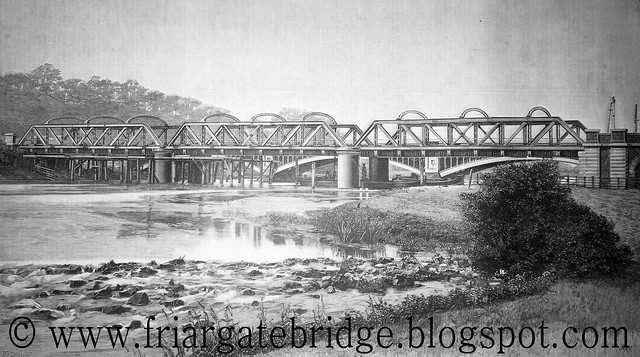
At 2.47 I have shown a illustration of the bridge from my 1873 catalogue by A.Handyside and I have faded it into my 2018 photo from the same vantage point so you can see how its changed. Notice the round floodlights of Trent Bridge Cricket club appear.
The bridge has six lamp standards, each in the centre of the three spans on both sides.
Aside from the bridge there are 15 lamp standards on brick pillars inlayed with decorative tiles, these are located on the approach to the bridge in a wedge shaped bit of land between Arkright Street and London Road. In my 1873 guide it says "The lamp standards for lighting the approaches are dwarf columns fixed upon stone pillars. All the lamps are globes in one piece of glass, with copper finials and mountings, and supplied with gas in the usual manner."
Here is a photograph I took of one of them, I would say those bases are not the original ones ! Maybe these lamps used to be closer to the approach of the bridge but they were all moved back here at some point, any one know ?

It has four carved stone refuges above the piers either side of the centre span, these are recesses along the parapet where pedestrians can come out of the
way of traffic, This is normally a feature of 16th Century bridges.
At 0.30 you can see the barrel vault structure inside the pedestrian tunnel on the west bank.
This video footage is from when I visited the bridge in April and May 2018 but only just got around to creating this video.
Points of interest in my video :
00:00 South side view of the three arches at water level.
00:12 Close view of one of the decorative spandrels.
00:17 View underneath showing the different construction method where the bridge was widened in 1926.
00:25 North side view of one of the arches.
00:30 Walking through the pedestrian tunnel, stonework by Benton and Woodiwiss of Derby.
00:40 The East abutment and reveal of arch.
00:51 View of southern side arch from the east bank.
01:01 View of the southern side arches from the west bank.
01:04 View of two Piers supporting the refuges.
01:19 Walk along the decorative parapet.
01:36 Close look at one of six decorative lamp standards.
01:56 View of the northern side arches from the west bank.
02:09 View of the southern side arches from the east bank.
02:29 View of southern side parapet, stonework and first arch from the west bank.
02:47 An 1870 Illustration from the 1873 catalogue by A.Handyside.
02:51 The same view but 148 years later.
02:56 View of the Northern side arches from the west bank.
03:01 Close view of one of the ironwork on one of the spandrels.
03:06 Close view of a decorative parapet.
03:10 Close view of one of the decorative spandrels.
03:15 Close view of a decorative parapet.
03:20 Sign showing A. Handyside & Co as contractors for the Ironwork.
03:24 View showing where the bridge was widened in 1926.
03:29 Walk towards the west arch on the Southern side.
03:59 Ducklings with bridge in background. Like, Share and Subscribe if you like my videos.
04:16 End.
My Reference :
Page 153 Example No 25
Works in Iron - Bridge and Roof Structures by Ewing Matheson of the firm Andrew Handyside and Co., Engineers, Derby and London. Published by E & F.N. Spon 1873.
This bridge is also engraved in Gold on the front of this book and illustrated on the Frontispiece.
To see many more bridges that were built by Andrew Handyside see my dedicated blog to their work: http://friargatebridge.blogspot.com/
► Please like, Share, subscribe and turn on notifications.
Feel free to share the link to Facebook, Twitter to anyone you think would like to see it.
Music Credits :
Silver Lining by Lights & Motion
https://youtu.be/Ozwo5Qx-zEo
Thanks
Andy